Introduction
aixplain agents are autonomous systems that plan, delegate, and adapt at runtime. On each run, an agent breaks a goal into steps, selects tools dynamically, calls models and data sources, runs code when needed, and continues under built-in access and policy enforcement until completion criteria are met.
There are two ways to build and deploy them:
aixplain Studio: visual builder for non-technical users and mixed teams.SDK/API: technical path for developers who need code-level control.
Who this is for
This documentation is for developers and technical teams who need to move from prototype to production without building orchestration, governance, and operations infrastructure from scratch. Non-technical users building agents visually should start with aixplain Studio.
Use aixplain when you need:
- Agent behavior that adapts at runtime.
- First-class integration with tools, data, and external services.
- Access to 900+ models, tools, and integrations across vendors, with swappable models.
- Production controls for security, cost, quality, and reliability.
What can you build?
Deploy agents that reason over enterprise data, run multi-step workflows, and integrate with existing systems inside your firewall.
Ingest, retrieve, and synthesize information from large document collections, filings, and technical archives with GraphRAG.
Give agents natural language access to complex relational schemas with Text-to-SQL while keeping data inside your environment.
Compose networks of specialized agents where each agent can call others as tools and coordinate through the runtime.
Deploy agents with runtime compliance enforcement for regulated and high-trust use cases.
Give internal teams or customers a governed path to build and deploy agents using approved models, retrieval, and compliance controls.
Multilingual and Arabic-first support
aixplain agents handle Arabic and other right-to-left (RTL) languages natively across the full stack: instructions, input, tool calls, sub-agent delegation, and responses. Unicode is preserved end to end, including diacritics (tashkeel), Arabic punctuation (؛ ، ؟), Arabic-Indic numerals (٠١٢٣٤٥٦٧٨٩), and mixed Arabic and Latin content. Support is model-agnostic, so you can swap providers without changing your Arabic instructions. This makes aixplain production-ready for Arabic-first markets, legal, government, finance, and customer service, across the Middle East and North Africa.
How it works
aixplain runs your agents on the Agentic OS: one governed runtime that spans the full lifecycle, from build through evaluation, deployment, monitoring, and continuous improvement.
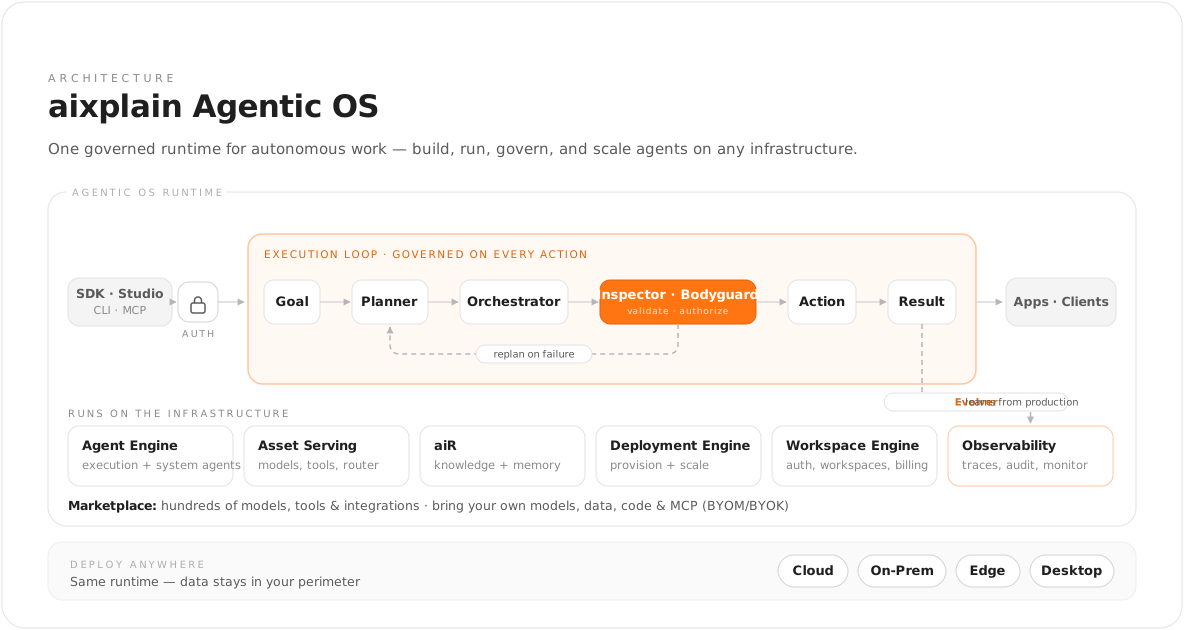
- Your agents: your application-level agent behavior and toolset.
- System agents: aixplain's built-in agents. In-loop agents (Planner, Orchestrator, Inspector, Bodyguard) coordinate planning, execution, validation, and access control on every run. Inspector and Bodyguard operate inside the execution loop alongside human-in-the-loop checkpoints, so governance scales beyond what human review alone can cover (see Inspectors). Lifecycle agents (Mentalist, Architect, Matchmaker, Debugger, Evolver, Bel Esprit) design, build, debug, deploy, and continuously improve your agents.
- Agentic OS: the runtime and control layer for execution, governance, memory, observability, deployment, and data control.
Architecture
The Agentic OS is built for speed and trust, without locking teams into a single model, surface, or deployment boundary:
- Portable: run across cloud, on-prem, edge, and local (including air-gapped) with no infrastructure or model-vendor lock-in.
- Governed: keep control, visibility, and auditability over builders and agents, including who can access what and which actions are allowed.
- Future-proof: let agents improve from production signals while the runtime absorbs model and vendor changes under governance.
Core services
The Agentic OS runs on six infrastructure services, each owning one layer of the stack:
| Service | Description |
|---|---|
| Agent Engine | Runs your agents and the in-loop system agents that plan, orchestrate, validate, and authorize every step. |
| Asset Serving | Executes and routes model, tool, and integration calls behind one standardized interface. |
| aiR (Retrieval Engine) | Ingests, stores, and retrieves your data (vector, graph, and SQL), and backs long-term and shared memory. |
| Deployment Engine | Provisions, scales, and serves agents across cloud, on-prem, edge, and local. |
| Workspace Engine | Identity and tenancy: authentication, workspaces, role-based access control, API keys, and billing. |
| Observability | Traces, audits, and monitors agent and model runs in production. |
Agent Engine
The Agent Engine is the core orchestration and execution layer. It manages the full agent lifecycle, from configuration through execution, coordinating planning, memory, and tool calls on every run. It runs aixplain's system agents: in-loop agents that govern execution at runtime, and lifecycle agents that improve agents across their lifecycle.
| Service | Description |
|---|---|
| Agent Runtime | Executes single and team agents asynchronously at scale: serverless deployment, session isolation, multimodal support (text and image), multi-agent coordination, and resilience through step retries, replanning, and timeouts. In-loop agents (Planner, Orchestrator, Inspector, Bodyguard) handle planning, routing, validation, and access on every run; lifecycle agents (such as Evolver) design, evaluate, deploy, and improve agents. Tool invocation is governed by allowed actions scoped at the agent level. |
| Guards | Runtime enforcement housing Inspector and Bodyguard. Intercepts every tool call before execution. Inspector validates inputs and outputs at checkpoints inside the execution loop: PII redaction, content moderation, jailbreak detection, hallucination detection, custom compliance policies, and human approval. Bodyguard enforces access controls and permissions at the asset boundary. Together they operate alongside HITL checkpoints so agents scale without scaling manual review. |
| Memory | Context-aware agents with full control over what the agent remembers. Short-term (within a session), long-term (across sessions), and shared (across agents). Opt-in, and never used by aixplain for model training. |
| Code Execution | An isolated sandbox for agents to run code, expanding their ability to solve complex, end-to-end tasks. |
Asset Serving
Asset Serving executes and routes model, tool, and integration calls, keeping interactions within your infrastructure perimeter. It puts a standardized interface between assets and agents so they stay swappable and modular.
| Service | Description |
|---|---|
| Server | Executes model and tool invocations. Routes requests to the correct supplier, handles async polling, and exposes an OpenAI-compatible interface. Supports hundreds of models and tools across vendors. |
| Router | Directs requests to the optimal endpoint at runtime: supplier fallbacks, model-level retries, timeouts, and logic-based routing such as switching to the lowest-cost model. |
| Integrations | Connects agents to services and data through OAuth and authenticated connections. Manages provider action catalogs, trigger subscriptions, async tool execution, and MCP exposure. Converts APIs and MCP-compatible tools into agent-callable functions and connects to existing MCP servers. |
| Assets | Catalog of models, tools, integrations, and pre-built agents. Every asset is reachable through the same outlets, SDK, API, and MCP, with standardized specs for comparison, integration, and swappability. |
Observability
A unified view to trace, debug, and monitor agent and model performance in production, with step-by-step visualizations to inspect execution paths, audit intermediate outputs, and debug failures.
- Visual execution traces across agent and model runs.
- Telemetry for latency, usage, cost, and error analysis.
- Monitoring retained across managed and self-hosted deployments.
- Runtime visibility surfaced in Studio and available to lifecycle agents such as Evolver.
Deployment and resilience
The same agent definition runs across every environment, with no rewrite:
- Web: fully managed on aixplain infrastructure, no provisioning required. See Deployment.
- On-prem: runs inside your own infrastructure, including air-gapped (zero outbound connectivity); data never leaves your network. See Deployment.
- Desktop: run agents locally on your own machine. See Deployment.
No single model, endpoint, or infrastructure dependency becomes a point of failure:
| Capability | Description |
|---|---|
| Model portability | Agent logic, tools, subagents, governance policies, and memory stay intact when models change. |
| Fallback models | Up to three fallback LLMs in priority order for automatic failover. |
| Automatic optimization | Prompt formats, tool invocation, schemas, token budgets, and sampling adapt to the target model. |
| Execution resilience | Stateless execution, retries, timeouts, failover, and human approval checkpoints reduce runtime failure risk. |
Security and data handling
See aixplain Security.
| Category | Capability |
|---|---|
| Data handling | Inference runs in memory by default. The only persisted data is opt-in, such as embeddings for RAG and agent memory when explicitly configured. |
| Data sovereignty | Full control on-prem and local; no data leaves your network. |
| Encryption | TLS 1.2+ in transit across all deployments; AES-256 at rest on cloud. |
| Access control (Bodyguard) | Role-based access control, API keys scoped to specific models with least-privilege, optional enterprise SSO, and asset/action-level restrictions enforced at runtime. |
| Auditability | All API, SDK, and UI actions logged and traceable by asset ID, deployment version, and usage logs. |
| Policy enforcement (Inspector) | Runtime validation on every execution: PII redaction, content moderation, jailbreak detection, hallucination detection, citation checks, custom compliance policies, and human approval checkpoints. |
| Isolation | Session-scoped, stateless execution by default; sandboxed tool execution. |
| Staff access | On-prem and local: zero aixplain staff access. Cloud: restricted to designated engineers under audit logs. |
Pricing and credits
- 1 credit = $1 USD
- Builder plan — pay-as-you-go via Stripe.
- Team plan — subscription for high-volume usage.
- Enterprise — custom pricing with SLAs and dedicated support.
Direct model usage is billed at vendor rates. Deployed agents are billed at vendor rates plus a 20% service fee. View detailed pricing.
Recommended start path
- Run your first agent with Quick Start.
- Add tools and integrations from Tools.
- Configure runtime policy with Inspectors.
- Integrate agents into your application with Integration.
Deploying your agent: app.aixplain.com deploys instantly on the cloud, with pay-as-you-go billing on deployed agents; your agent lives in your workspace. To run agents locally with local or cloud-based models and tools, download aixplain Desktop (coming soon). For On-Prem or Edge deployments, contact us.
Where to get help
- Documentation — quick start, tutorials, and API reference.
- FAQs — common questions on building, deployment, pricing, security, and the SDK.
- Discord community — connect with developers and the aixplain team.
- Enterprise contact — custom deployments, dedicated support, and SLAs.